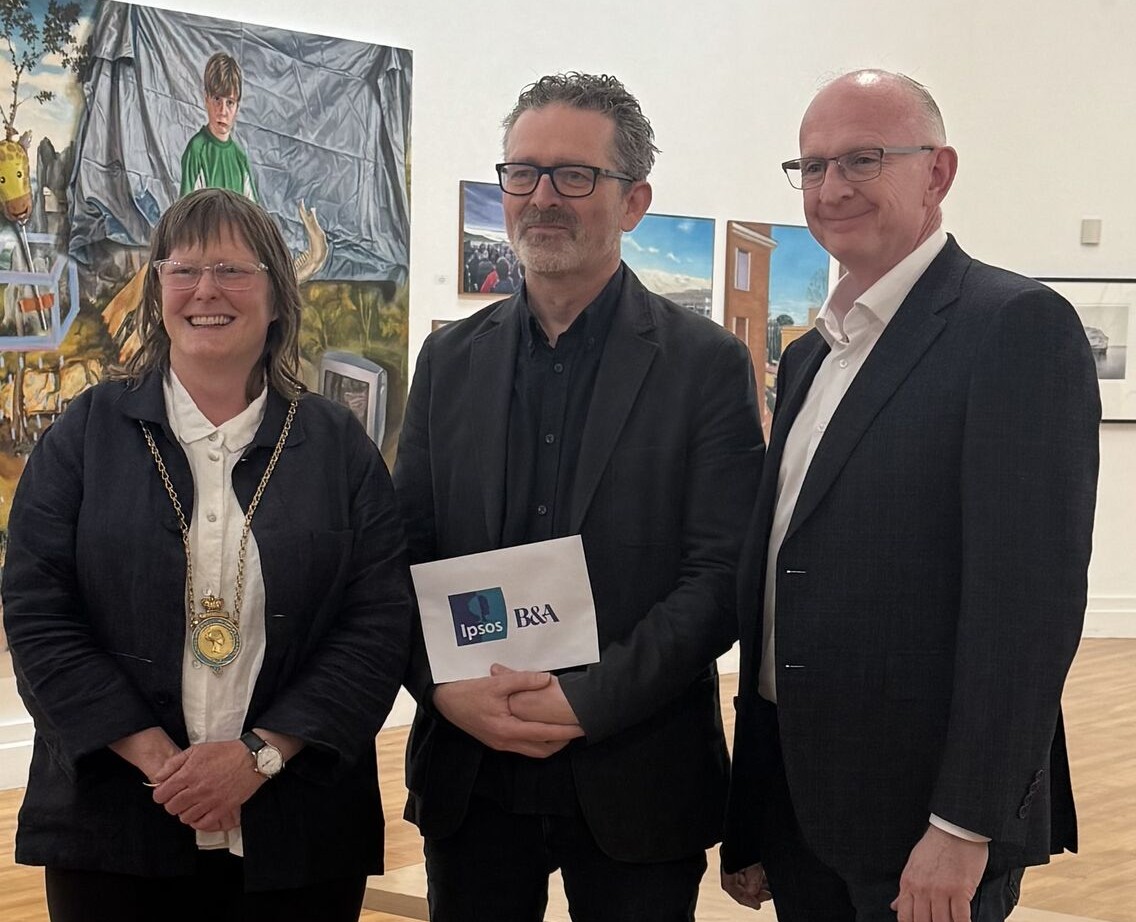



SOTT is our annual deep-dive into the Irish cultural zeitgeist, exploring how consumers are really thinking, feeling, and making decisions in a world that keeps shifting beneath their feet.
We’ve been running this research since 2010, and it draws on our year-round immersion with Irish consumers, society and culture – hundreds of focus groups, interviews, digital ethnography, and large-scale quant studies – alongside bespoke qualitative work and a nationally representative survey conducted specifically for this project.
The shifts we’re seeing in Sign of the Times 2026 aren’t subtle. Consumer mindsets, trust dynamics, and decision-making habits have fundamentally changed – shaped by economic pressures, AI, geopolitical uncertainty, and cultural recalibration. These changes carry real implications for how brands communicate, position, and connect.
Understanding where Irish consumers actually are – emotionally, culturally, practically – is essential for smarter decision-making around messaging, targeting, product development, brand and channel strategy.
The Era of Resigned Resilience
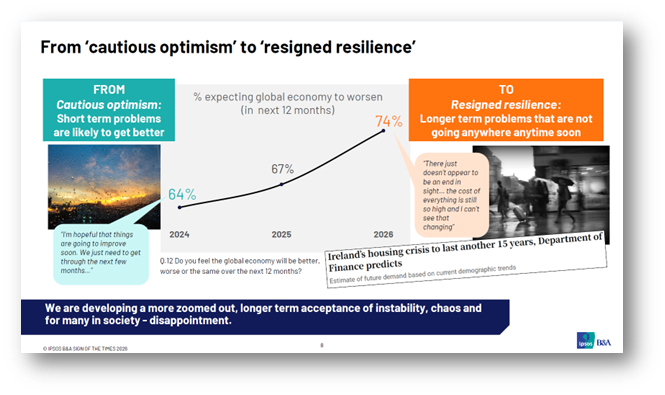
Perhaps the most striking finding is the emotional evolution we’ve observed over the past year. Irish consumers have moved from what we characterise as “cautious optimism” – that distinctly Irish belief that if we just hunker down and get through the next few months, things will improve – to what we are calling “resigned resilience.”
This isn’t defeatism; it’s pragmatism. Our Ipsos B&A data shows that 74% of Irish adults now expect the global economy to worsen in the next twelve months, up from 64% just two years ago.
But what’s fascinating is that people are not panicking. Instead, they’re emotionally checking out. After years of overlapping crises – financial crisis, pandemic, energy crisis, inflation, geopolitical chaos – we’ve quite literally run out of shock.
In our focus groups, participants describe creating “bubbles of normalcy” around their kitchen tables. One participant told us, “We just don’t talk about all that awful stuff happening out there… instead we talk about our holidays, good food, we laugh.” This isn’t apathy; it’s self-preservation. Joy has become medicine, and lightness has become a survival strategy.
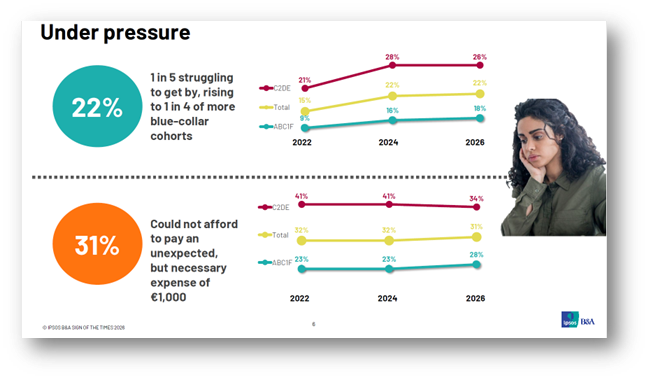
While the latter is how we are aiming to cope, we need to acknowledge that cohorts of our society at a fundamental level are under pressure. One in five are struggling to get by, rising to one in four of blue-collar individuals. And 31% of people now could not afford to pay an unexpected, but necessary expense of €1,000.
Ireland’s Identity Renaissance
Simultaneously, we are witnessing something remarkable: a cultural reawakening. As global certainties crumble, Irish consumers are anchoring themselves in what feels authentically theirs. And the data is compelling – the growth of #Gaeligetiktok has exploded on TikTok, attendance at League of Ireland matches was up 11% in 2025, and searches for “Learn Irish online free” have risen 40% on Google search in the past year.
This is not mere nostalgia. In a world where traditional role models are failing – particularly our complicated relationship with America – we are reaching back to our roots for stability.
Our relationship with the USA is forcing us into an uncomfortable reckoning between moral conviction and economic dependency. The numbers tell a striking story: 76% of Irish people believe we should prioritise the EU for international alliances in the coming years, while only 35% say the same for the USA. Perhaps most telling, 38% now favour prioritising international alliances with Canada. All this against the backdrop of knowing our economic reality is deeply tied to US multinationals.
There is significant emotional disappointment with the USA. It feels like a best friend revealing values you didn’t know they held. That being said, the economic pragmatism of the importance of USA for the economy and jobs tempers our moral dismay. We’re caught between our conscience and commerce.
The implications for brands and organisations are profound. In an era of globalised sameness, authentic cultural specificity becomes a differentiator. But there is a delicate balance to strike. Performative “Irishness” will be rejected as quickly as overtly American branding might now carry unexpected baggage. In a world of chaos, our language, our music, our sport, our stories, become something solid to stand on.
The AI Revolution Has Already Started
We need to be unequivocal about this: the AI revolution isn’t coming – it’s here. Our Ipsos B&A research shows that 51% of AI users are already using it as an alternative search engine, and 46% use it for learning and research. For organisations and brands still debating whether to develop an AI strategy, we have sobering news: you’re already behind.
We are witnessing a fundamental shift from ‘searching’ to ‘asking’. Traditional SEO – optimising for keywords and fighting for page-one rankings – is giving way to what we call AI-EO (AI Engine Optimisation). In this new paradigm, the game isn’t about driving traffic to your website; it’s about being comprehensible to AI systems that will answer questions before consumers ever reach your site.
Consider this scenario we tested: instead of Googling “best running shoes for flat feet,” consumers are having conversations with AI: “I’m 38, 6’1″, 210 lbs, running 15 miles weekly, flat feet, history of knee pain, mostly pavement. Which shoes should I try?” The AI responds with personalised, contextual recommendations.
The brands that will thrive are those with crystal-clear differentiation. Fuzzy positioning – that comfortable middle ground many Irish businesses have occupied – will get you buried in AI recommendations. You need to know exactly what makes you different and be able to articulate it with precision.
“What we are witnessing here is the consumer journey and decision-making process being rewritten in real time. The shift from ‘searching’ to ‘asking’ changes everything in terms of how customers will interact with brands”. Niall Brennan, Account Director, Ipsos B&A
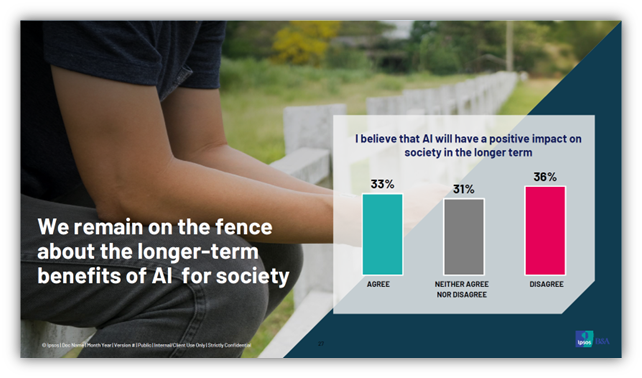
However, people are divided on whether AI will have a positive impact on society in the longer term:
The Repricing of Human Value in an AI World
Yet paradoxically, as AI capabilities expand, the value of human connection is being repriced upwards. The Sign of the Times research reveals deep anxiety about human relevance, with 61% agreeing that ‘with AI, it will become more challenging for individuals to achieve mastery in their field’. “” But this anxiety is creating opportunity.
We’ve identified clear boundaries in consumer acceptance of AI. Whilst people welcome AI solving medical problems or aiding product selection, 73% consider AI-generated art or music as less meaningful than human creation. Time signals care. Effort creates intrinsic value. The process matters as much as the outcome.
The organisations or brands that win will use AI for efficiency—while protecting the human friction that signals meaning to customers.
An AI chatbot might efficiently answer product queries, but when a customer needs to feel valued, human intervention becomes the premium offering.
Or will AI develop deep emotional personalities? While most of us remain distant emotionally from AI, worryingly there are signals that the next generation may be somewhat different. The Ipsos B&A Sign of the Times report reveals that 22% of 16-24 year olds (AI users) are using AI for emotional support or companionship.
“AI can strip friction out of customer experience entirely – but that’s not always the goal. Friction signals effort, and effort signals value. The smartest brands will use AI for speed where speed matters, then deliberately slow down at the emotional touchpoints. It’s not about choosing between efficiency and humanity – it’s about choreographing both.” Niall Brennan, Account Director, Ipsos B&A
The Circle of Trust
The information landscape has become exhausting and treacherous. There is a growing sense that we need to be always on and always vigilant and a realisation of the intentions that sit behind the information we consume.
Trust has never been more fragile or more valuable. Less than half of Irish adults (48%) are confident they could identify AI-generated images.
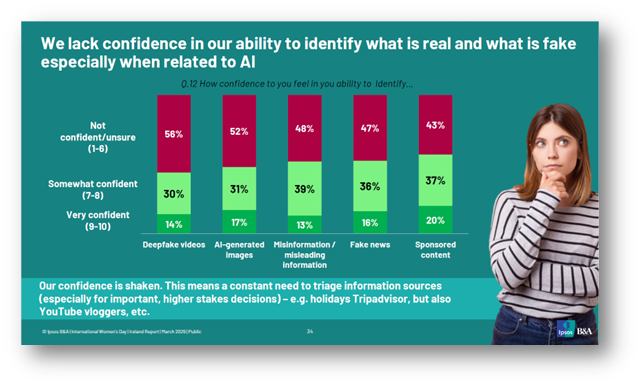
In response, consumers are channelling what we call their “inner Jack Byrnes” (Robert De Niro’s character from the Meet the Parents films) – becoming deeply sceptical gatekeepers, constantly asking, “Who are you? Why should I believe you?”
The result? A dramatic tightening of trust circles. WhatsApp group recommendations, friends with direct experience, proven experts – these proximate, verifiable sources are becoming the new gold standard. Discussion sites such as Reddit and Boards.ie appear to be experiencing a renaissance as sources perceived to be “not yet corrupted” by AI or bad actors.
For brands and organisations, this means radical transparency isn’t optional anymore. Employee voices, founder authenticity, genuine customer advocacy – these become your most valuable assets. Micro-influencers trump celebrities. Community-building trumps broadcasting. Word-of-mouth, always important in Ireland, has never been more powerful.
The Performance Nation
Perhaps nowhere is modern anxiety more visible than in what we’re calling “Our Performance Nation.” Two-thirds (67%) of Gen Z report feeling pressure to optimise everything in their lives. Gen Z in particular now navigate impossible contradictions:
- Be highly productive AND present.
- Be ambitious/hustling AND at peace/content.
- Be crushing goals AND practising gratitude.
- Have experiences AND life progression.
Even self-care can feel more pressured rather than offering relief. The desire for pampering and nurturing in self-care is overshadowed by the need to tick boxes, transforming it into a preservation routine. The focus on doing everything ‘correctly’ adds pressure, emphasising the ‘right’ products and rituals, which can contradict the true essence of self-care. Skincare routines, exercise regimens, sleep optimisation – what should provide relief has become another source of pressure.
We’re seeing “performance escalation” everywhere. Hen parties became weekends, became trips abroad, became productions with matching outfits, Instagram accounts, and professional photographers. The growth of ‘trophy travel’ is evident. The language surrounding travel has become a telling indicator of its growing performative nature. Travel has evolved from just being an experience to accomplishment – “we did Vietnam” – with the anticipated social media sharing actually shaping real-time experience.
But nothing says “performance nation” quite like knowing how little you perform. When it comes to social media behaviour, even strategies people initially used to reduce usage have morphed into their own form of social currency. Take the rise of the “photo dump” – those sporadic, ‘intentionally unpolished’ posts meant to replace the constant stream of curated content has evolved into its own performative flex. The message isn’t “look how connected I am” but “look how disconnected I can afford to be.”
For brands, offering permission to be imperfect, to step off the optimisation treadmill, becomes genuinely countercultural and interesting. Consider ‘Pudding mit Gabel’ (“pudding with a fork”), a TikTok trend that swept mainland Europe in late 2025 in which large groups on people met in parks to eat pudding with a fork instead of a spoon. Messy. Inefficient. Gloriously pointless. It resonated precisely because it was unproductive – a small, silly rebellion against the pressure of being “always on.” We feel examples like this points to a deeper consumer need – permission to let the guard down. Permission for small acts of release. Permission to be playful without purpose.
In all the seriousness of self-improvement, there is more room for play and fun from brands that can be tapped into –consumers miss this.
Stuck Together
Finally, we cannot discuss Irish consumer behaviour without addressing the housing crisis. This isn’t just an economic issue; it’s fundamentally rewriting life stages and family dynamics. It Is impacting what people buy, their travel patterns, commutes, etc. Young adults living with parents longer, having children later, parents extending financial support well into their children’s thirties and forties – these aren’t temporary adjustments but structural changes.
The unspoken tensions are palpable. Young adults feel infantilised yet grateful. Parents want to help whilst fearing they’re enabling dependence. Both generations are navigating unprecedented territory with no roadmap.
For marketers, this means completely rethinking life-stage targeting. The traditional markers – leaving home, marriage, children – are delayed, scrambled, or reimagined entirely. A 35-year-old living at home whilst saving for a deposit represents an entirely different consumer than traditional models would suggest.
Looking Ahead
“As I reflect on the Ipsos B&A Sign of the Times 2026 findings, I’m struck by both the challenges and opportunities they present. Irish consumers are navigating extraordinary complexity with remarkable resilience. They’re not waiting for stability to return; they’re creating new frameworks for living with instability.” Luke Reaper
“For businesses, the message is clear: the old playbooks won’t work as effectively. You need to be lighter, more transparent, more human, and more precise than ever before. You need to understand not just what consumers are doing, but how they’re feeling and why they’re adapting.” Luke Reaper
The brands that will thrive are those that offer genuine value in this new landscape – whether that’s the efficiency of AI, the authenticity of human connection, the relief of permission to be imperfect, or the trust that comes from radical transparency.
We’re not just tracking trends anymore. We’re documenting a fundamental reimagining of Irish life. The question isn’t whether your brand will adapt, but how quickly and how authentically you can evolve to meet these new realities.
“The future isn’t what we expected. But for brands and organisations willing to listen, learn, and genuinely engage with these shifts, it’s full of possibility.” Luke Reaper, CEO Ipsos B&A Ireland
“What we are witnessing here is the consumer journey and decision-making process being rewritten in real time. The shift from ‘searching’ to ‘asking’ changes everything in terms of how customers will interact with brands”. Niall Brennan, Account Director, Ipsos B&A
“AI can strip friction out of customer experience entirely – but that’s not always the goal. Friction signals effort, and effort signals value. The smartest brands will use AI for speed where speed matters, then deliberately slow down at the emotional touchpoints. It’s not about choosing between efficiency and humanity – it’s about choreographing both.” Niall Brennan, Account Director, Ipsos B&A
About the Ipsos B&A Sign of the Times 2026 report:
The report is underpinned by bespoke consumer research designed exclusively for this report. It leverages our extensive cultural understanding accrued from conducting numerous focus groups, in-depth interviews, digital ethnography, and comprehensive consumer and business surveys annually
- Online Consumer Groups: With immersive pre-tasking, we’ve conducted five focus groups encompassing the BC1/C2D segments, ages 16-70, across various locations. Fieldwork for these groups happened in February 2026
- National Online Survey: This was conducted by Ipsos B&A for the Sign of the Times study, featuring a nationally representative sample of 1,042 adults aged 16 and over. This survey took place from 24th February to 5th March 2026
- Ipsos B&A Consumer Confidence: Another nationally representative survey, with a sample of 1,010 adults aged 16+. This fieldwork was carried out from 10th – 20th March 2026.
This comprehensive methodological approach ensures that our insights are grounded in a robust, evidence-based understanding of the consumer landscape heading into 2026.
Ipsos B&A is offering clients a face-to-face or online dedicated session. Please contact carole.carmody@ipsos.com.
For more information, please contact Niall Brennan (Account Director): niall.brennan@ipsos.com